
Understanding Cross-Dialect Readiness: What Migrates Cleanly
A breakdown of cross-dialect readiness — which schema object types translate cleanly between SQL dialects and which need manual review.
Concepts and best practices for schema management across SQL dialects.
A breakdown of cross-dialect readiness — which schema object types translate cleanly between SQL dialects and which need manual review.
What a database schema diff tool does, how it works, and the situations where it saves you from painful production surprises.
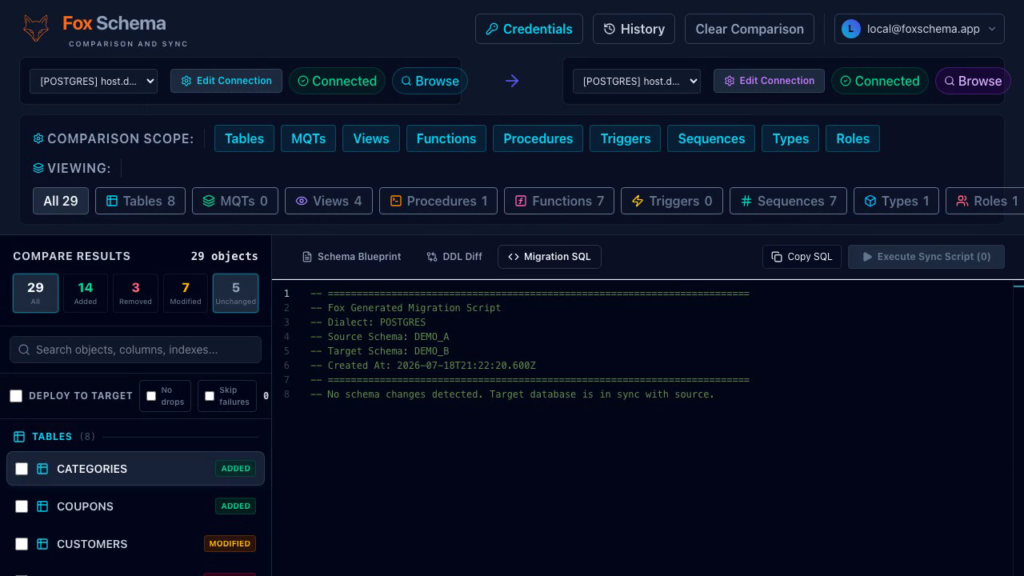
How to detect and fix schema drift across per-tenant or shared-schema multi-tenant databases, and how to roll out migrations across many tenants safely.
A schema-level look at migrating from Oracle to PostgreSQL — NUMBER types, sequences, and the objects that need manual review.
The criteria that separate the best database migration tools from basic ones: readable generated SQL, cross-dialect awareness, dry-run safety, and CI fit.
How to plan safe rollbacks for schema migrations: reversible vs irreversible changes, pre-migration snapshots, and testing the rollback itself.
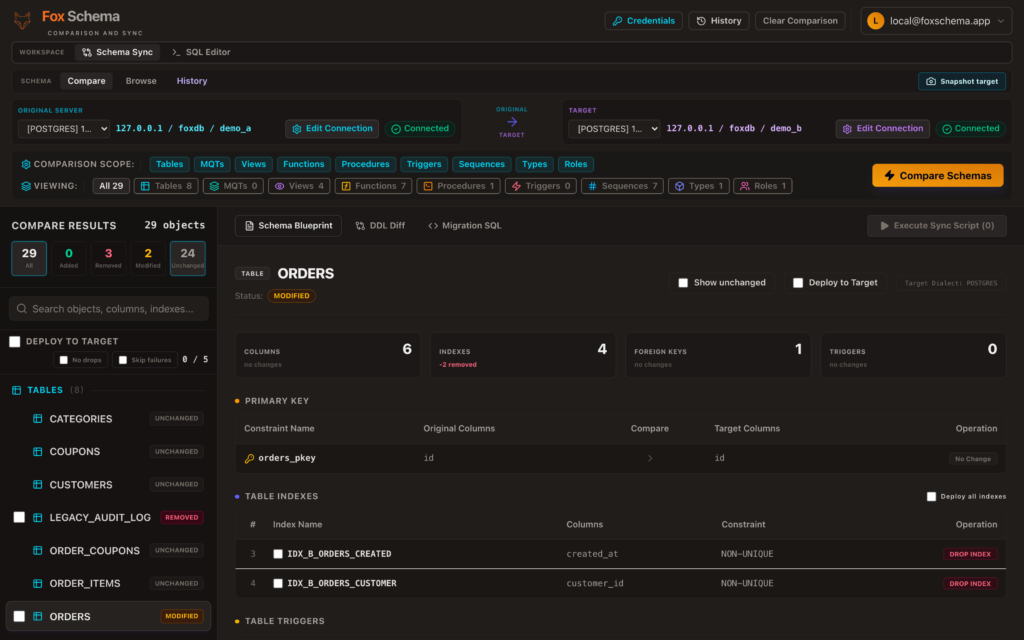
How to add columns, change types, and backfill huge tables without long locks: native online DDL per dialect, expand/contract, batched backfills, and gh-ost.
How PostgreSQL, MySQL, MariaDB, SQL Server, Oracle, and SQLite differ on stored vs. virtual generated columns, and what breaks when you migrate them.
How PostgreSQL, MySQL, SQL Server, and Oracle differ in partition syntax, key constraints, and what breaks when you migrate a partitioned table.
Comparing integer and UUID primary keys: storage size, B-tree index locality, UUIDv4 vs v7, and the pattern of using an integer key with a UUID alias.
