
Moving an analytics workload off PostgreSQL and onto a columnar warehouse means more than copying tables — a PostgreSQL to Redshift migration touches data types, constraint enforcement, and storage concepts that Postgres doesn't have at all. Redshift speaks enough of the Postgres dialect that the two look alike on the surface, which is exactly what trips people up.
Why PostgreSQL and Redshift Diverge at the Schema Level
Redshift is a fork of an old PostgreSQL codebase, but it was rebuilt around columnar, massively-parallel storage rather than row-oriented OLTP. That rebuild changed what a "table" means: Redshift cares about how data is distributed across compute nodes and sorted on disk, neither of which has a Postgres counterpart. It also means some very ordinary Postgres behavior — enforced foreign keys, in-place `ALTER COLUMN` type changes — simply isn't there. Treating the two as interchangeable dialects during a migration is the most common source of surprises after cutover.
Data Type Differences to Map Before You Migrate
Most scalar types translate cleanly (integer, bigint, boolean, date, timestamp), but a few need deliberate handling:
texthas no direct match — Redshift maps it tovarchar(max), which caps out at 65,535 bytes per row shared across all VARCHAR columns.uuidisn't a native type in Redshift; it's stored asvarchar(36), so uniqueness and formatting checks that Postgres enforced natively become the application's job.jsonandjsonbmap to Redshift'ssupertype, which supports semi-structured querying but with different functions than Postgres's JSON operators.- Binary types (
bytea) becomevarbyte, with different size limits.
None of these are hard blockers, but each one usually needs a review pass on the application queries that touch the column, not just the DDL.
Identity Columns, Sequences, and Constraints That Don't Enforce
Postgres's GENERATED ALWAYS AS IDENTITY becomes Redshift's IDENTITY(seed, step) syntax — a mechanical rewrite, but one that's easy to miss if you're hand-porting DDL. See our guide to sequences and identity columns across dialects for the full comparison.
The bigger gotcha is constraints. Redshift accepts PRIMARY KEY, FOREIGN KEY, and UNIQUE in your CREATE TABLE statements, but it does not enforce them at write time — they're informational, used by the query planner to make better join decisions. A Postgres schema that relies on the database to reject a duplicate key or an orphaned foreign key will silently accept both in Redshift. That validation has to move into the ETL/ELT layer or the application before it lands in the warehouse.
Distribution and Sort Keys Have No Postgres Equivalent
Postgres has nothing resembling a DISTKEY or SORTKEY, because a single-node row store doesn't need to think about where data physically lives. Redshift does: DISTSTYLE/DISTKEY decides which node a row lands on (get it wrong and every join redistributes data across the cluster at query time), and SORTKEY decides the on-disk order that scan-pruning relies on. These aren't something a schema-diff tool can infer from a Postgres source — they're a warehouse-specific design decision made from your actual query patterns, applied once the table structure itself has landed.
Altering Existing Tables: What Redshift Won't Let You Do In-Place
Postgres will happily run ALTER TABLE ... ALTER COLUMN ... TYPE ... against a live table with rows in it. Redshift won't — there's no in-place column type change. The standard workaround is to add a new column with the target type, backfill it, drop the old column, and rename, or to recreate the table entirely via CREATE TABLE AS and swap it in. Any migration plan that assumes a one-line ALTER COLUMN will port cleanly from Postgres needs to budget for this extra step.
Comparing Schemas and Generating the Migration SQL
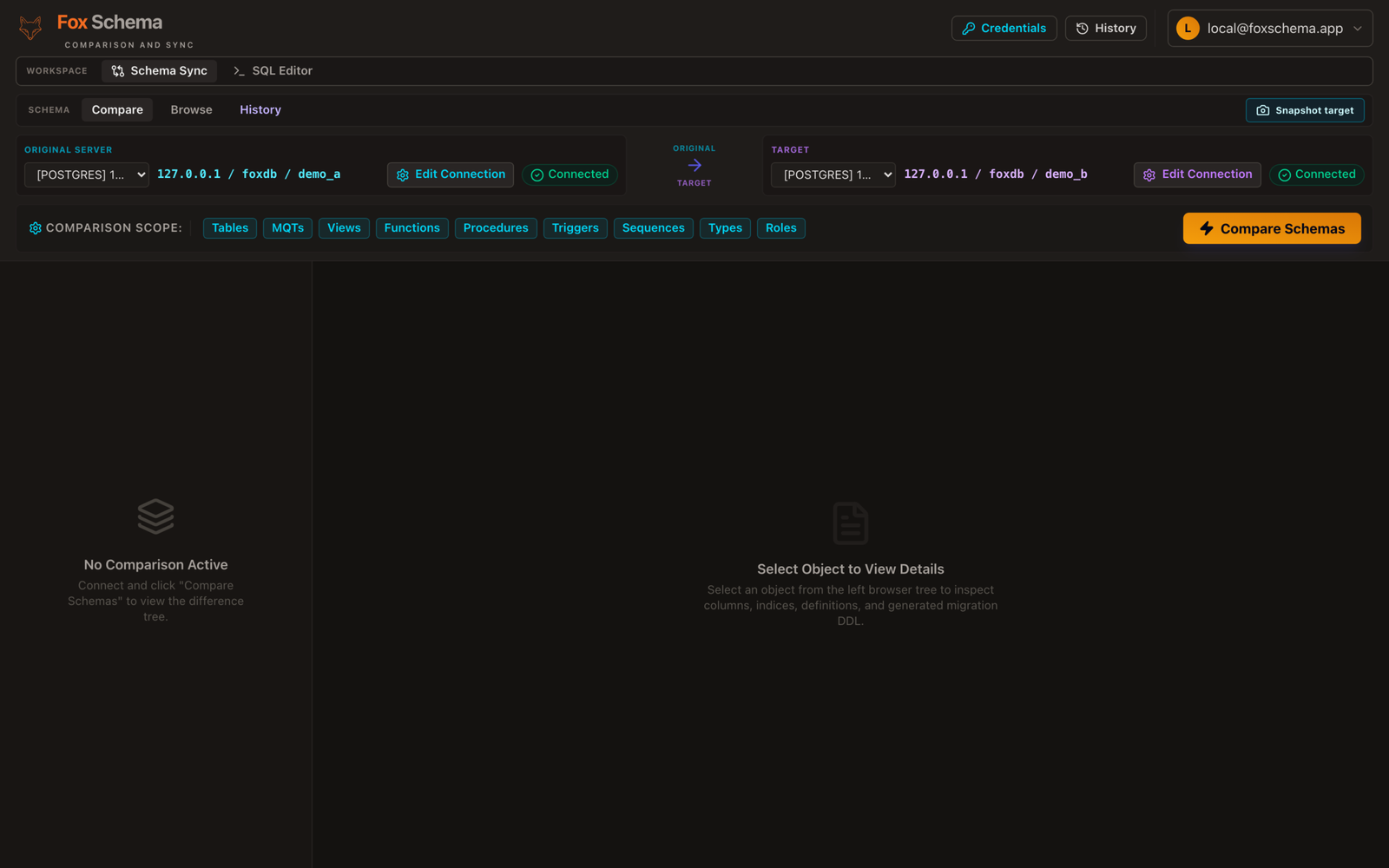
FoxSchema handles the mechanical side of this: point it at your PostgreSQL source and Redshift target, and it diffs tables, columns, keys, and indexes, then generates dialect-correct migration SQL — including the IDENTITY(0,1) rewrite and the recreate-and-backfill pattern for column type changes it can't express as a single ALTER. Its readiness panel separates what translates cleanly from what needs a human decision, like distribution keys, sort keys, and any constraint you were relying on Postgres to enforce. It never writes to the source, and nothing runs against the target until you apply it. For a closer look at how the diff and SQL generation work end to end, see comparing two schemas and generating migration SQL; the same workflow applies to other columnar-warehouse targets like ClickHouse.
Ready to try it on your own schemas? Self-host FoxSchema in Docker or check the docs to get a PostgreSQL-to-Redshift comparison running in minutes.
