
MySQL to ClickHouse migration is less a matter of translating syntax and more a matter of rethinking the schema entirely, because ClickHouse is a column-oriented, analytics-first database and MySQL is a row-oriented, transactional one. Getting the table engines, keys, and nullability right up front saves you from a slow rebuild later.
Why teams make this move
MySQL is excellent for OLTP: point lookups, small transactional writes, and enforcing referential integrity. Once reporting queries start scanning millions of rows for aggregates — dashboards, event analytics, time-series rollups — MySQL's row storage becomes the bottleneck. ClickHouse stores data by column and is built for exactly that scan-and-aggregate workload, often returning results orders of magnitude faster on the same hardware. The trade-off is that ClickHouse deliberately drops several relational guarantees MySQL schemas take for granted.
Row store vs. column store changes the schema, not just the engine
A MySQL table maps loosely to a ClickHouse table, but the underlying storage model is different enough that a literal column-by-column copy rarely performs well. ClickHouse tables belong to an engine family — most commonly MergeTree and its variants (ReplacingMergeTree, SummingMergeTree, AggregatingMergeTree) — and the engine choice determines how rows are sorted, merged, and deduplicated on disk. The ORDER BY clause you choose for a MergeTree table effectively replaces the role MySQL's primary key and secondary indexes played, since it defines the sort order used for range scans and skip indexes.
No traditional indexes, foreign keys, or triggers
This is the biggest structural gap when comparing schemas. ClickHouse has no B-tree secondary indexes, no foreign key constraints, and no triggers — they're absent by design, not an oversight. Referential integrity that MySQL enforced at the database layer has to move into the application or the ETL pipeline that loads ClickHouse. Constraints on a MySQL schema (foreign keys tying an orders table to a customers table, say) simply won't have a ClickHouse equivalent to migrate to, and any schema comparison should flag them for manual review rather than attempt a direct translation.
Nullability is encoded in the type, not a column modifier
MySQL expresses nullability with the standard NULL / NOT NULL keywords after the column type. ClickHouse instead wraps the type itself: a nullable integer column is declared Nullable(Int32) rather than INT NULL. It's a small syntactic difference but an easy one to get wrong by hand, since every nullable column needs its type rewritten, not just a keyword appended. Non-nullable columns should stay bare where possible — wrapping everything in Nullable() defensively costs ClickHouse real query performance, since it disables some column-level optimizations.
Auto-increment and identity don't carry over cleanly
MySQL's AUTO_INCREMENT assumes a single writer coordinating a counter. ClickHouse is built for distributed, high-throughput inserts, so there's no direct equivalent — ID generation typically moves to the application (UUIDs) or a monotonic function evaluated at insert time. Similarly, unique constraints don't exist as an enforced invariant; deduplication is handled after the fact by engines like ReplacingMergeTree, which is a very different consistency model than MySQL's immediate uniqueness check.
What to check before you migrate
Before generating any migration SQL, run a proper schema comparison between the two databases and read the readiness output carefully. Tables and columns generally translate cleanly with type mapping; indexes, foreign keys, and triggers will not, because ClickHouse has no equivalent object to target. Views also behave differently — ClickHouse views can be normal or materialized, and only the latter actually stores computed data, which is a meaningfully different tool than a MySQL view. Treat anything flagged as "needs manual review" as a real modeling decision, not a formatting fix.
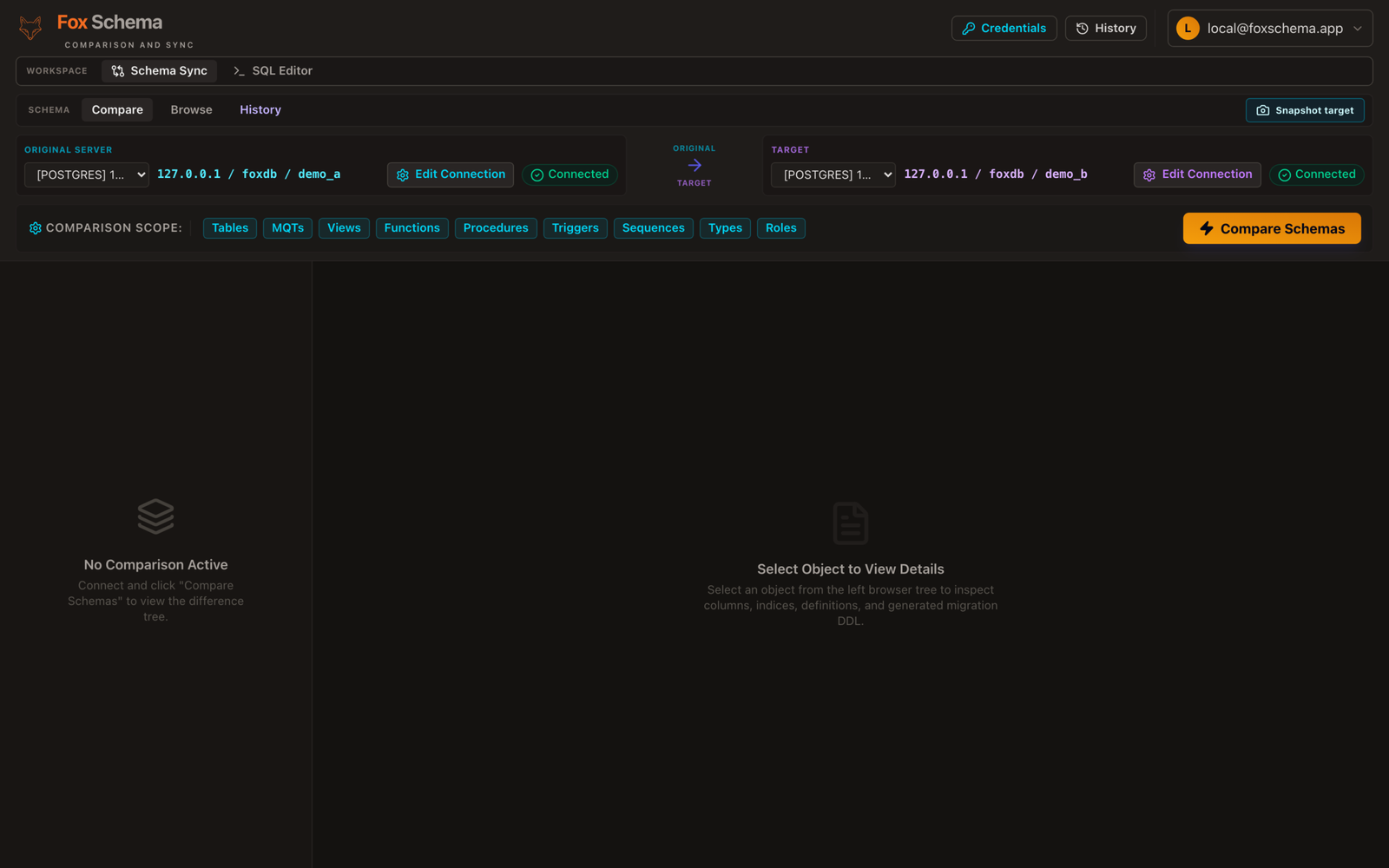
FoxSchema compares MySQL and ClickHouse schemas side by side, generates the migration SQL for the parts that map cleanly, and calls out the objects that need a human decision instead of guessing. See the documentation for dialect-specific notes, or read about self-hosting FoxSchema in Docker if you'd rather run it on your own infrastructure. Ready to try it? Install FoxSchema and compare your first MySQL and ClickHouse schemas.
