
If you're planning a cross-dialect migration, views and materialized views across database dialects are one of the areas most likely to catch you off guard — they look like simple, portable objects, but under the surface they're dialect-specific SQL wrapped in a name, and that SQL rarely survives a straight copy-paste to a different engine.
A view is just SQL with a name
A regular view is nothing more than a stored SELECT statement that gets re-run every time you query it. That sounds portable, but the body of the view is written in one dialect's SQL dialect: PostgreSQL string concatenation uses ||, SQL Server uses +, and MySQL wants CONCAT(). Date arithmetic, window function syntax, quoting rules, and even how NULL sorts by default all diverge. A view that compiles cleanly on Oracle can fail outright — or worse, succeed but return different rows — on Db2 or MariaDB.
There's no reliable automated way to rewrite an arbitrary view body from one dialect's SQL to another; the transformation would need to be a full SQL-to-SQL compiler covering every function and operator difference, not a schema mapping. That's why schema comparison tools generally treat a cross-dialect view as something a human needs to look at, not something safe to auto-translate.
Materialized views aren't even universally available
Materialized views add a second layer of divergence, because the feature itself isn't consistent across engines:
- PostgreSQL has native
CREATE MATERIALIZED VIEWwith manual or scheduledREFRESH. - Oracle supports materialized views with query rewrite and several refresh modes (fast, complete, on-commit).
- IBM Db2 calls the equivalent object an MQT — a Materialized Query Table — with its own
REFRESH TABLEmechanics and eligibility rules for what queries can back one. - MySQL, MariaDB, and SQLite have no true materialized view object at all; teams typically fake one with a regular table plus a scheduled job or trigger that repopulates it.
Migrating a materialized view from Postgres to MySQL isn't a syntax problem you can patch — the target simply doesn't have the concept, so the migration has to become an architectural decision (a cron-refreshed table, an event, or a change in how the application reads that data) rather than a generated CREATE statement.
What "full support" actually means for a schema diff tool
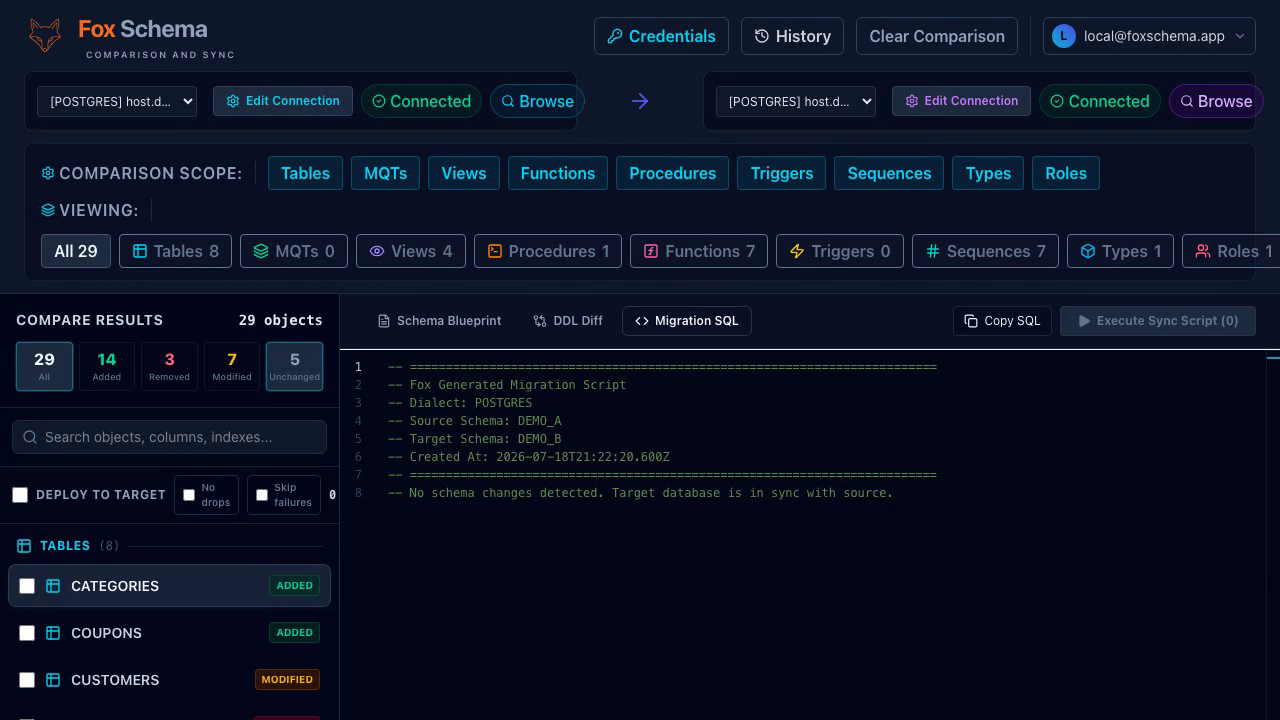
When a schema-diff tool tells you an object type is fully supported cross-dialect, it usually means the object is structural — a table's columns, primary keys, foreign keys, and indexes describe shape, not behavior, so they translate cleanly through a canonical type system. Views and materialized views aren't structural in that sense; their contents are executable code. FoxSchema's own cross-dialect readiness panel reflects this directly: tables, columns, keys, and indexes show full readiness, while view bodies are flagged manual review required and the original SQL is included as a comment in the generated migration rather than being silently rewritten. That's a deliberate choice — surfacing the gap up front is safer than generating DDL that looks correct and isn't.
A practical approach to migrating views cross-dialect
- Inventory every view and MQT/materialized view before you start — don't discover them mid-migration.
- Rewrite view bodies by hand against the target dialect's syntax, testing each one against real data, not just a syntax check.
- For materialized views moving to a dialect without the feature, decide up front whether a scheduled table refresh is fast enough for your use case, or whether the query needs to run live instead.
- Keep views low on your migration priority list relative to tables — get the structural schema migrated and verified first, since application correctness depends on it more directly.
- Re-run your comparison after manual view fixes land, so the diff tool confirms nothing else drifted while you were editing SQL by hand.
Same-dialect migrations are a different story
None of this applies when source and target use the same dialect — a view body doesn't need translation if it's already valid SQL for the target engine, so those migrate as a straight CREATE VIEW statement. The manual-review burden is specifically a cross-dialect cost, which is worth factoring into any decision to standardize on one database engine versus running a mixed fleet. See our guide on cross-dialect schema migration for how this plays out for other object types.
Try it yourself
FoxSchema compares schemas across 10 SQL dialects and generates the migration SQL, with a readiness panel that tells you up front which object types — including views and materialized views — need a manual look before you deploy. Read the docs or self-host it in Docker to try it on your own schemas.
