
Moving off IBM Db2 usually starts with the application layer, but the schema is where the real friction lives — a Db2 to PostgreSQL schema migration touches sequence semantics, identity columns, tablespaces, and naming rules that don't map one-to-one. Get those details wrong and you end up with a schema that looks right until the first bulk insert or nightly ETL job trips over a mismatched default.
Where Db2 and PostgreSQL schemas actually diverge
Both are mature, standards-leaning relational databases, so the gap is narrower than, say, Oracle to MySQL — but it's not zero. The differences that bite in practice:
- Identity vs. sequence defaults. Db2's
GENERATED ALWAYS AS IDENTITYandGENERATED BY DEFAULT AS IDENTITYmap conceptually to Postgres identity columns (or a linked sequence withnextval()as the default), but the increment, start value, and cache settings need to be copied explicitly — they don't come along for free. - Tablespaces and bufferpools. Db2 schemas are often tied to named tablespaces with specific page sizes. Postgres tablespaces are simpler — usually just a storage location — so this mapping is typically a simplification, not a like-for-like translation.
- Schema-qualified naming. Db2 defaults to uppercase, unquoted identifiers; Postgres folds unquoted identifiers to lowercase. A table created as
CUSTOMERSin Db2 becomescustomersin Postgres unless you quote it, which changes how every downstream query has to reference it. - Column types. Db2's
DECFLOAT,GRAPHIC/VARGRAPHIC, andXMLtypes have no exact Postgres equivalent.DECFLOATgenerally maps tonumeric, but precision and rounding behavior should be verified against real data, not assumed. - Check constraints and defaults using Db2-specific functions. Anything referencing Db2 built-ins (date/time functions,
CURRENT SCHEMA, sequence-related expressions) needs a Postgres-native rewrite — these don't translate automatically.
Objects that need manual review, not just translation
Tables, columns, primary keys, and standard indexes translate cleanly in the vast majority of cases. Four categories consistently need a human to look at them first:
- Stored procedures and functions. Db2's SQL PL and Postgres's PL/pgSQL diverge in syntax, cursor handling, and error trapping — rewrite these by hand rather than machine-translate them.
- Triggers. Row-level vs. statement-level semantics differ enough that a straight port can silently change firing order.
- Views over Db2-specific catalog functions or federated objects. These have no Postgres analogue and need a rewrite of the underlying logic.
- User-defined types. Db2 UDTs usually map to Postgres domains, but constraint behavior should be checked case by case.
A practical migration sequence
Sequencing matters more than most teams expect:
- Snapshot the Db2 schema and run a structural comparison against a fresh, empty Postgres target to see the full delta before writing anything.
- Migrate tables, columns, primary keys, and foreign keys first — the highest-confidence, lowest-risk translations.
- Recreate sequences and identity columns next, explicitly matching increment, start, and current values so new rows don't collide with migrated data.
- Port indexes, then re-benchmark — Db2 and Postgres have different query planners, so a Db2-tuned index set isn't automatically right for Postgres.
- Leave stored procedures, triggers, and complex views for last, and budget real engineering time — this is where automated tooling should hand off to a human.
Validate before you cut over
Once the schema is in place, run the comparison again against the live target as data loads in. Catching a dropped NOT NULL constraint or a truncated VARCHAR length before go-live is far cheaper than finding it in a production incident. A readiness view that separates "translates cleanly" from "needs manual review" is worth building into your process even if you're doing the migration by hand — it turns a vague "did we get everything" question into a concrete checklist.
Where a schema diff tool fits in
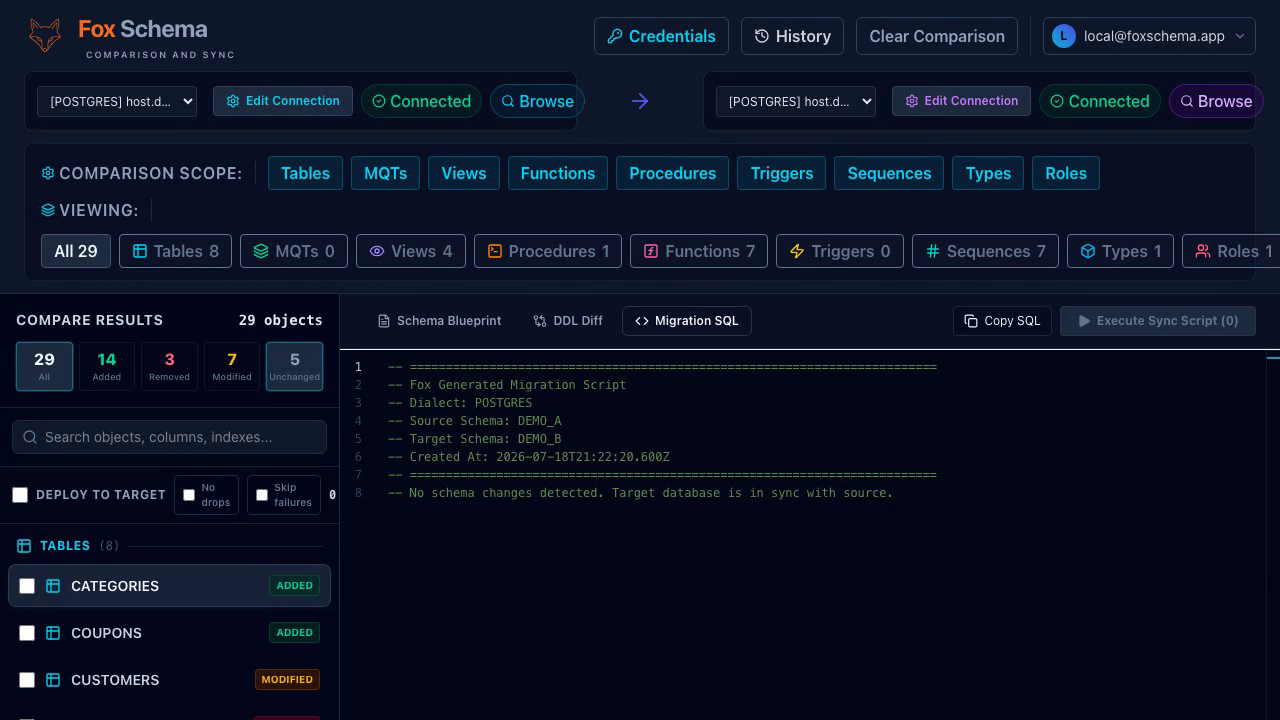
Hand-writing DDL for a full Db2 schema is tedious and error-prone at any real scale. FoxSchema connects to both databases, produces a structural diff between the Db2 source and Postgres target, and generates the migration SQL for the objects that translate cleanly — tables, columns, keys, indexes — while flagging views, UDTs, and procedural code for manual review instead of guessing at a translation. You can compare schemas and generate migration SQL repeatedly as you iterate, which matters because Db2-to-Postgres migrations are rarely one-shot: you'll run the comparison, fix a mapping, and run it again.
Get started
If you're planning a Db2-to-PostgreSQL move, start with a read-only comparison against a copy of your Db2 schema before touching production. Self-host FoxSchema in Docker or check the install guide for the CLI, then read the docs for connection setup specific to Db2 and Postgres.
